

Who Works As A Squirrle Brusher To Harvest The Hair For Makeup Brushes?
The sole aim of this article is to offering data to curious consumers to aid illuminate some manufacturing materials and processes for products they may want to buy; not to judge, upset, or alienate anyone.
As consumers, we all take the right to spend our money how and where we run into fit (that'due south the beauty of capitalism), however the importance of the choices we make equally consumers cannot exist overstated. Our purchasing choices can drive the economy and direct new innovations.
Over the years I've heard a number of people express concerns well-nigh the utilise of animate being by-products in the products they use everyday, and art materials are no exception. The world of fine art products is indeed vast; fortunately, the number of creature-based products is pocket-sized and easy to outline.
- Pigment Brushes
- Oxgall
- Sizing
- Scarlet Red Paint
(At that place may be more, merely these are the ones you're most likely to run into)
Paint brush manufacturers are the unmarried biggest users of animal by-products in the fine art materials industry.

i. Paint Brushes
Brushes tin can be made of sus scrofa bristles, badger, mongoose, pony, squirrel, sable, wolf, goat, ox, camel, raccoon, rabbit... the listing goes on. Each type of pilus offers its own unique strengths.. The method of harvesting brute hairs varies from place to place, and from fauna to animal. The only thing that is universal virtually fauna hairs is the secrecy of their harvesting.

Trying to notice a straight answer on the cyberspace is completely infuriating. Most of the information bachelor is offered up by brush manufacturers or animal hair suppliers to the brush-making industry who are all trying to sell us something. They'd accept us believe that all animal hairs are delicately harvested in a warm sunny field by teenage girls wearing white gloves... This is a nice thought, merely information technology'south just non accurate.
The other side of this consequence is championed past organizations like PETA, who accept documented animal abuse atrocities that cannot be contested; however, whether their evidence is indicative of industry-wide practices, or of individual companies behaving deplorably is up for debate.
Some natural hairs used in brushes are worth highlighting for the concerned consumer...
Hog Beard:

Overview: Hog bristles brushes are made from the fibroid hairs on the dorsum and neck of a pig, which are stiff yet springy. The beard have natural split-ends (flagged ends), which increases the amount of paint they hold and helps to maintain precision in the brush's border or indicate. Squealer bristle brushes tin can be used for both oils and acrylics. They historic period adequately well, condign softer and more responsive with employ, but natural bristles will become dry out and breakable after longer utilize, and will eventually brainstorm to break off. Hog beard can be white or black, depending on the colour of the squealer.

Facts: Whether a bristle castor was made in Sri Lanka, Germany, or Italy the hog bristles themselves almost certainly came from China. Mainland china has a monopoly on hog beard; information technology has been the worlds main supplier of grunter beard for decades (and possibly centuries). Specific breeds of pigs were/are raised specifically for their bristles. All the same, times are changing and these breeds are less common on Chungking manufacturing plant farms now (every bit farmers in China are raising pigs more for their meat than for bristles) leading to a growing shortage and sharp price increase on hog beard. (College prices frequently give consumers the impression of something being better or of higher quality, which is not necessarily the case.)

Opinion: People's republic of china doesn't really have a expert record when it comes to protection of beast rights. I can say with absolute certainty that teenagers wearing white gloves ARE Not involved in the harvest of pig bristles. The actual harvest methods range from bad to worse to horrific, with picayune to no regulation and monitoring of animal welfare.
Caprine animal:

Overview: Caprine animal hairs are white or black (depending on the caprine animal) and are very soft and absorptive. Goat hairs are normally used as flat wash brushes for watercolours and inks. (All Japanese hake brushes are white goat pilus.) The best goat hairs for brush-making are taken from the breast of the goat.

Fact: In one case again, Prc is the primary supplier of the worlds goat hairs.
Opinion: I couldn't observe any in-depth data on the farming and harvest of goat hairs. Although goat meat is a staple of many diets effectually the world, goats are likewise raised for their milk and so it'due south viable that goats are simply being sheared regularly for their hairs.
Sable:

Overview: A sable is a mink-like weasel (from the marten family) that lives in forested mountain regions of Russia (Siberia), northern Mongolia and Kazakhstan; this animal is a black sable which is known for its luxuriously soft black and silver hairs. Blackness sable makes an ideal brush for blending with oils. There is likewise another member of the marten family that can be constitute in the Ukraine and Romania that has a reddish coat; the hairs from this animal are marketed as ruby-red sable and are sought after past watercolourists for their absorbency and resilience.


Facts: The finest quality black sable hairs come up from animals that are trapped in the wild because domestic/subcontract-raised sable don't grow the same quality coats as their wild counterparts practise. The red sable is mainly farmed (as opposed to trapped) making blood-red sable brushes less expensive and easier to observe than black sable.

Wolf:

Overview: Traditional Chinese and Japanese calligraphy brushes use soft and absorbent goat hairs in the heart of the castor surrounded by long, strong wolf guard hairs that enable the brush to hold an fantabulous betoken.
Fact: Wolf are also farmed in huge numbers specifically for their fur.

Opinion: If you're someone who would never support wearing fur, you may want to consider sable and wolf brushes with the aforementioned critical centre; the unfortunate reality is the residue of that animal is being worn on someones dorsum, or as boots or a handbag... you become my signal. Sable and wolf hairs used in paint brushes are off-cuts from the fur manufacture. Information technology just so happens the the fur on the beast's breast, abdomen, cervix and tail are parts non generally used in making fur coats and collars, just they practice brand excellent paintbrush hairs. (Waste not, want not, I suppose.)
Annoy:
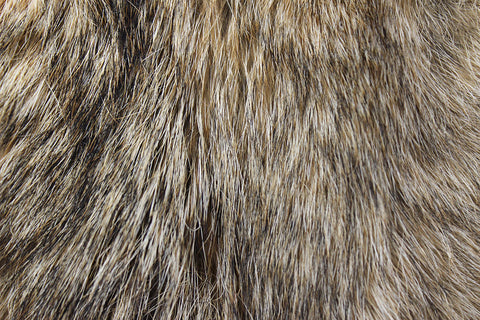
Overview: Annoy hair brushes are the oldest, most traditional type of brushes used for oil painting on sail because the hairs are stiff and snappy. Strands of badger hair are thinner at the base and get wider at the tip giving the brush a "bushy" advent. This shape allows badger hair brushes to work very well for painting specifically with oils. Badgers are very mutual animals in the wild so their hair is more than abundant than most other natural hairs used to make brushes. Annoy pilus is besides used for cosmetics brushes (men's shaving brushes especially).

Fact: China is the globe leader in annoy pilus production. Badgers are plentiful in southern Cathay and are regarded equally land/ingather destroying vermin, and detested as carriers of rabies. Annoy meat is inedible merely their pelts have value; this has lead to badgers being trapped and hunted en masse for the bounty on their hides. It'south not possible to breed badgers on farms so they are always harvested from the wild. Although annoy hunting requires a license, information technology is otherwise unregulated and is carried out mainly by individuals using whatever methods they see fit.
Squirrel:

Overview: In the artistic earth, Squirrel pilus brushes are sought after by watercolourists for their sable-like properties just at a much more affordable price. In add-on, most brushes made for the cosmetic industry consist of some (if not all) squirrel hairs.

Facts: Squirrels are farmed in large numbers for both castor-making purposes, and for the fur industry equally. The long hairs from squirrel tails get brushes, and the pelt generally becomes a garment or fashion accessory of sorts.
Camel:

Overview: Most natural watercolour or tempera brushes for kids are camel. For the artist, wide camel hair brushes are useful for washes in ink and watercolour.

Facts: Camel brushes are not made of camel hair. The term camel is used manufacture-broad by paintbrush manufacturers for a brush that is a random mixture of curt, low-grade, soft hairs from heaven-knows-what fauna; it could even exist rabbit or true cat hair. This is why children's watercolour paint brushes (labeled equally came)l are often ridiculously inexpensive. Real camel pilus is very similar to muskox wool; fine, frizzy and extremely soft and featherlike (peachy for making cashmere, terrible for making paint brushes).
Try Synthetics?
Here at Cowan'south we admittedly acquit a very minimal supply of natural paint brushes, but that's not by accident, or by ignorance. I'k a painter likewise then I definitely practise sympathise what a great brush is all virtually, but as a purchaser for an art supply shop I have many choices to make about what products to behave. I personally prefer non to support natural hair brushes when constructed brush technology is so fantastic, and getting meliorate every year!
This is a natural Squirrel castor (Atelier Russian Blue Squirrel).
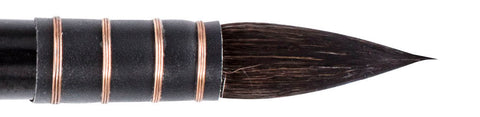
This is a synthetic Squirrel brush (Princeton Neptune).

Not simply do they await the aforementioned, their performance is nigh identical.
Many consumers have the impression that constructed brush fibers are cheap nylon mono-filament (like fishing line) cut bluntly and glued together, but the truth is quite the opposite. Synthetic brush development has become a highly competitive industry, with companies racing to develop the best synthetic brushes at the best prices. Artist quality synthetics are engineered to exactly mimic the structure of the animals natural hair, even on a microscopic level! Synthetic squirrel hairs have a wavy, undulating form with a naturally tapered tip just similar real squirrel hairs (like Heinz Jordan'due south Kazan Gold and Princeton'southward Neptune brushes). Synthetic hog bristles besides mimic the taper of a natural pig bristle and are just equally snappy and responsive (similar Connoisseur's Pure Synthetic Bristle Brushes) and far less prone to breakage.
Creative person quality synthetics are oftentimes less expensive than artist quality natural hair brushes, plus they'll likely have a longer life because the fibers don't get dry and brittle like natural hairs do.
two. Ox Gall (Oxgall)
Overview: Ox gall serves as a pigment flow addition when added to water media. Information technology works past lessening the surface tension of the water and enhancing the flow of washes (particularly when working on hot pressed or synthetic papers which tin repel washes and crusade puddling). Ox gall likewise aides in color mixing and blending techniques. If a watercolour wash is non covering the newspaper evenly, is beading upward, or declining to absorb into the deep texture of the paper (leaving tiny white specks), artists will add a drop of ox gall to better menses and even out the absorbancy. Ox gall can also exist diluted and applied to paper before painting to brand it more than receptive to watercolor paint. Overuse can result in a ho-hum finish, so information technology should be used sparingly.


Facts: Ox gall is gall (bile) obtained from cattle after slaughter. Information technology'south mixed with alcohol and used equally a wetting agent in paper marbling, engraving, lithography and watercolour painting. It can be a clear to yellow to green-brown liquid and is a natural mixture of cholesterol, lecithin, taurocholic acrid, and glycocholic acid.
Stance: Ox gall is indeed a very handy medium to take equally a watercolourist. Simply, even if you're non a vegan or vegetarian, the whole notion of painting with bile is pretty gross if you stop to think about it. The expert news is that constructed ox gall is readily available and functions exactly like the cow-based stuff, just less icky.
3. Sizing
SIZING AND WATERCOLOURS: Sizing is a substance (such as hibernate glue, gelatin, or acrylic polymer) added to watercolour paper during the manufacturing procedure, serving several fundamental purposes:
- to reduce the absorbency of the paper (helping paint sit on the outer surface of the paper, as opposed to soaking into the interior of the sheet)
- to maintain the structural integrity of the newspaper (and so the newspaper tin be soaked with water without falling autonomously)
- to reduce paper buckling and warping in one case dry (encourages paper to shrink back to it'due south original shape; flat)
Sizing can exist internal (added to lurid during manufacturing) and/or external (added to the paper's surface after production). The highest quality watercolour papers have both internal and external sizing.
When it comes to watercolour papers, information is difficult to observe because paper manufacturers closely guard their methods. I was able to find out that Arches and Saunders Waterford still use hide glue and gelatin as sizing, whereas Fabriano is proudly committed to using constructed sizing in all of their products. I was unable to detect any definitive information on the types of sizing used by other brands such as Winsor & Newton, Canson, BFK Rives, Strathmore, and Stonehenge.
Opinion: Since synthetic polymer-based size is far less expensive than using hide gum or gelatin sizing, I would retrieve information technology's relatively safe to assume that most brands are not using beast-based sizing anymore. Every bit polymer-based size is non the near traditional sizing, manufacturers may worry that their newspaper will exist viewed as a lesser quality product if it'due south known they utilise synthetic, hence the secrecy about the type of sizing used.

SIZING AND OILS: Raw canvas and boards should exist sealed with sizing to protect them from the acidity and degrading effects of linseed oil. (Acrylics are inert and can be applied directly to canvas without sizing.) The nigh traditional substance used equally sizing is hide glue. The purpose of the sizing is to seal the fibers of the canvas or forest lath allowing the ground (ordinarily gesso) to bond to the mucilage instead of the support; this prevents the support from absorbing your linseed laden ground and paint.

Fact: The most traditional type of hide glue sizing is rabbit skin mucilage. This is made by humid rabbit skins in h2o until the soupy mixture thickens into a natural hide glue. Another traditional size is gelatin, which is fabricated past boiling skin, horn, hooves, cartilage and other connective tissues from random animals (pigs, horse, cattle, sheep...).
An culling to hide glue (equally a support sealant) is Gold Paints' GAC-100 which seals the substrate and prevents transfer of acids through the substrate and into the ground, and vice versa.
four. Carmine Red Pigment

Overview: Traditionally, Carmine Lake is a deep red red colour, also called cochineal lake, crimson lake, or kermes lake. It is a non-toxic, heavily staining color used mainly in watercolours and gouache, equally a textile dye, every bit a red nutrient colour additive, and in cosmetics.

Facts: Red pigment is fabricated of crushed Cochineal insects which are native to South and Central America. Subsequently the Spanish explorers discovered the the popular red dye of the Maya people, information technology became 1 of Spain's leading exports for centuries. The cultivation and breeding the cochineal insects takes delicate human intervention, so in the late 19th century when a petroleum-based substitute was adult, the Carmine industry died overnight. The new synthetic replacement (Alizarin Crimson) was used for decades in place of the original Reddish, including as the about common red nutrient colourant, until information technology was proven to be carcinogenic. Alizarin is not only carcinogenic when consumed, it is also is not platonic equally a paint paint. (Recent studies have shown that Alizarin is prone to chemically breaking down over time, thereby compromising the paint moving picture integrity. Many pigment manufacturers have since changed their composition of Alizarin Crimson paints and renamed it Permanent Alizarin)

Long story short: Considering of our new agreement of Alizarin, almost makers of Carmine cerise dyes and paints have returned to using crushed cochineal insects because of its vibrant colour, its permanence and non-toxicity.

Opinion: The burdensome of insects to make paint may not be an issue for many people, but information technology does matter to some. If you lot're 1 of those that is bothered, I encourage you to look into the many uses of crushed bugs, because they're everywhere. These bug-based pigments are the pigments that are nearly normally used in cosmetics and in food (red dye #4).
If someone wants to emulate the iridescence of a butterfly wing, it can be achieved by using pigments loaded with mica (a type of stone) or with microscopic flecks of metal (such every bit anodized aluminum used in some automotive paints). However, using metals tin can present many problems when it comes to toxicity. Other iridescent pigments are created by using crushed irised beetles instead, which are considered to be non-toxic, hence why they're used in beauty and nutrient products.
As e'er, have fun, stay safe and paint on!
Source: https://cowans.org/blogs/cowans-art-knowledge-know-how/animal-by-products-and-art-supplies
Posted by: honeycuttspeakne.blogspot.com
0 Response to "Who Works As A Squirrle Brusher To Harvest The Hair For Makeup Brushes?"
Post a Comment